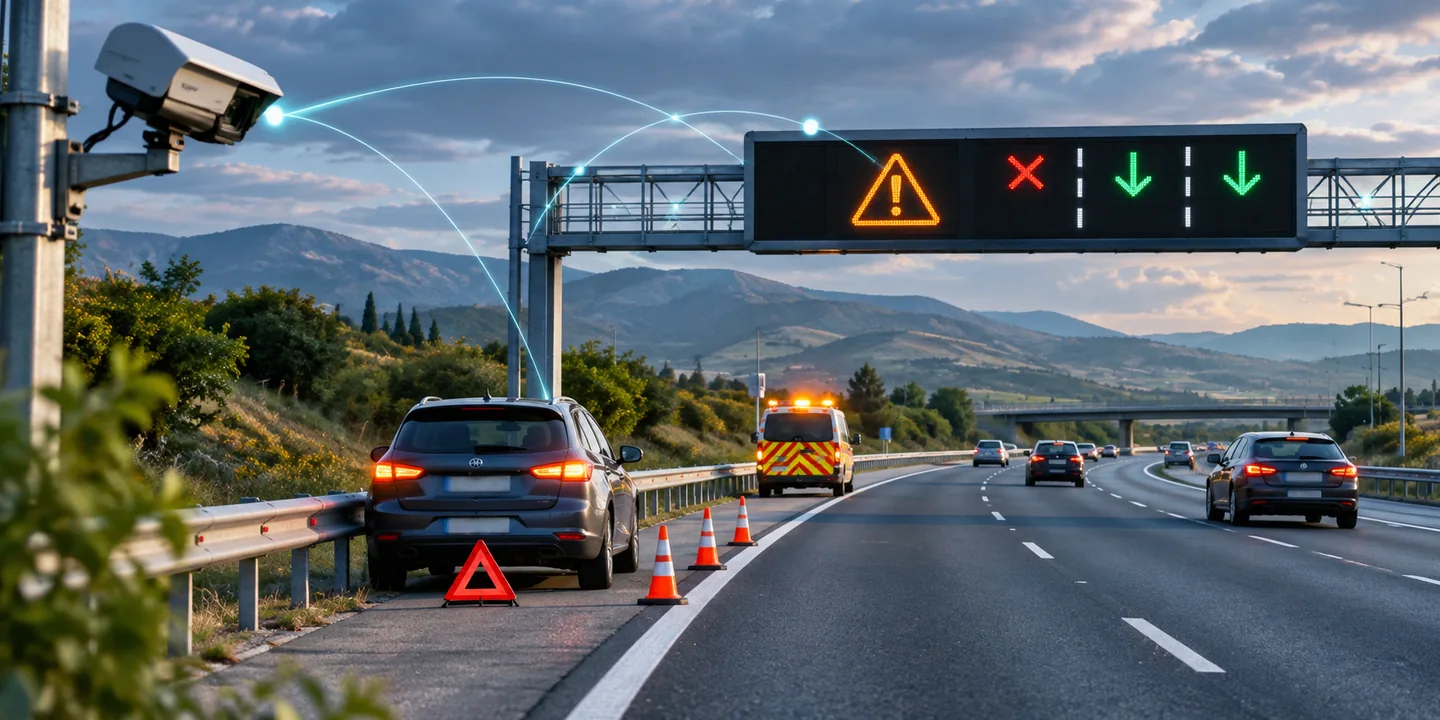

A journey across Europe may be continuous, but the digital information behind it is often maintained by different road authorities, operators and service providers. Interoperability allows these systems to exchange and understand information without forcing every organisation to use exactly the same software.
Why a common language matters
One traffic centre may describe a road closure using its own local categories and location references. A neighbouring service may use different conventions. Unless the two systems can translate the information consistently, a closure can be misplaced, duplicated or omitted from a traveller service.
Interoperability addresses more than file formats. It also includes the meaning of each field, location referencing, how frequently records are updated and which organisation is responsible for maintaining them. Common rules make information more reusable in traffic management, digital maps, logistics planning and traveller information.
National Access Points
Within the European ITS framework, Member States establish National Access Points to facilitate discovery and access to relevant transport datasets. They are intended to help data users find information for interoperable services without searching separately through every individual road operator.
The European Commission's overview of National Access Points explains this approach and its relationship with the ITS Directive. An access point does not by itself guarantee that every dataset is complete or immediately usable: data providers still need clear descriptions, maintenance processes and appropriate quality controls.
The framework has continued to evolve. The 2023 amendment to the ITS Directive reflects the growing role of connected mobility, digital travel services and the information needed to support them.
What DATEX II does
DATEX II is a European data exchange standard used for road traffic and travel information. It provides a shared structure for describing items such as traffic conditions, incidents, roadworks and other operational information, making it easier for independently developed systems to communicate.
Standardisation is valuable when several administrations need to exchange updates along a major corridor. A consistent description of a road event helps downstream services interpret the same situation correctly, rather than relying on custom arrangements for every connection between systems.
From datasets to useful services
Good data exchange should ultimately benefit the person or organisation using a transport service. It can improve the consistency of cross-border travel alerts, support coordinated traffic management and make route information easier to maintain. At the same time, system designers must address privacy, security, accuracy and governance wherever applicable.
The idea links directly with the cross-border cooperation central to the Trans-European Road Network. See the wider background in Trans-European Networks and the practical service perspective in Real-Time Traffic and Traveller Information.